
New Book Makes a Powerful Case for Ending Solitary Confinement
“How can we subject prisoners to unnecessary solitary confinement, knowing its effects, and then expect them to return to our communities as whole people?” —Barack Obama addressing the need for solitary confinement reform in 2016.
When I was senior editor for San Quentin News, it was rare to find articles in mainstream media outlets showing incarcerated people doing something socially responsible. Then, a piece in the Huffington Post about a prison service-dog training program caught my attention. It was written by Christopher Blackwell. The story dispelled some common misconceptions about the carceral system. Blackwell showed people in prison caring about the needs of local communities. He captured the humanity of one of what is perhaps the most demonized segment of our society.
Blackwell, 44, incarcerated in Washington State since 2003, has been given numerous writing awards and fellowships. He’s amassed support inside and outside of prison. He currently leads Look2Justice, a grassroots organization that provides civic education to system impacted communities and strives to pass sentence and policy reform legislation.
His latest work, Ending Isolation: The Case Against Solitary Confinement is a collaboration with Deborah Zalesne, a Professor of Law at the City University of New York School of Law; Terry Kupers, a psychiatrist with expertise in solitary confinement and Professor Emeritus at the Wright Institute in Berkeley, California; and Kwaneta Harris, a former nurse and business owner who is now an award-winning incarcerated journalist in Texas, Haymarket Writing Freedom Fellow, and Galaxy Gives Fellow.
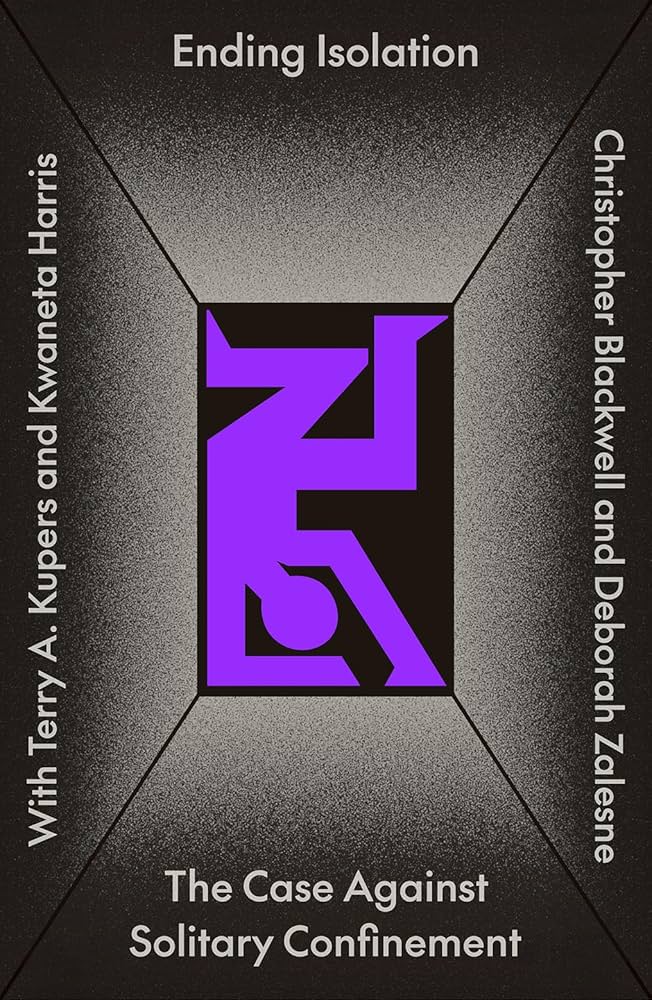
Collaboratively, the team breaks down common myths and misconceptions about the physical and psychological effects that solitary confinement has on people. It reads like a horror show transcript.
Blackwell recalls solitary confinement as “a drab and colorless realm: a world almost totally devoid of love or beauty… a world where chaos and depravity are the norm and normalcy is the rarest feature of daily life.”
Harris recalls life after solitary confinement: “I had over eight years of only walking handcuffed with ankle shackles. I’m used to taking small shuffling steps, stooped over my handcuffed hands grasping metal links attached to a belly chain leash. I still walked as if invisible chains were attached. Guards and friends constantly remind me: Stand up straight! Pull your shoulders back! Take big steps!”
What makes Ending Isolation a powerful read is that multiple interview subjects are consistent in their story about the bane of the criminal legal system’s worst policy—it saps away the humanity of those who undergo it. Moreover, half of prison suicides happen to people in solitary confinement.
Solitary confinement’s impacts are damaging and life-threatening to those who endure it, according to “The Science of Solitary: Expanding the Harmfulness Narrative.” This seminal article by psychologist and solitary confinement expert Craig Haney argues that after people are released from solitary confinement and go to the general prison population the damage persists. Even after the person goes home from prison, there is lingering damage. “The Science of Solitary” asserts that “psychological and physical consequences of social isolation, social exclusion, loneliness, and the deprivation of caring human touch as they occur in free society” is toxic even beyond the effects of imprisonment itself.
Ending Isolation supports the lingering damage argument found in “The Science of Solitary” with studies showing people who spent time in Isolation were 24 percent more likely to die within one year of release than those who weren’t placed in Isolation. Additionally, those who spent time in solitary were found to be 127 percent more likely to die of an opioid overdose within two weeks of release from prison.
From cover to cover, Ending Isolation puts readers inside the lives of those who undergo solitary, to argue a case against its use.
Racism found in solitary confinement practices cannot be ignored. Although Black men make up about 40 percent of the prison population, in federal and most state prisons, about 43 percent of the men in solitary confinement are Black men. Black women make up about 22 percent of incarcerated women, but 42 percent of the women in solitary are Black. By contrast, Black people are about 13 percent of the U.S. population.
In spite of overwhelming evidence that solitary confinement causes harm and premature death, prison officials tout that its use is a necessary tool to keep prisons safe and to curtail violence. However, a 2003 study examined the rates of violence in Arizona, Illinois, and Minnesota before and after supermax facilities were opened. In all three states, the rates of prisoner-on-prisoner violence stayed the same. Additionally, a significant increase in staff injuries followed the opening of a Special Management Unit in Arizona.
Courts, however, consistently back prison officials’ reasoning by focusing on physical needs rather than the psychological effects of isolation. The courts go on to assert that the use of solitary confinement is a “part of the penalty that criminal offenders pay for their offenses against society.”
Since the courts refuse to restrict prison officials’ use of solitary confinement, federal and state lawmakers are addressing the issue.
On the federal level, in 2003, Congress introduced the End Solitary Confinement Act. If passed, the law would ban solitary confinement in federal lockups and provide incentives for state and localities to do the same. The bill, however, languishes in the current Congress.
On the state level, since 2018, New York, Connecticut, Nevada, and New Jersey have passed legislation that prohibits more than 15 consecutive days in solitary confinement—a limit that has been codified in the UN’s “Mandela Rules,” which establish standards for the treatment of incarcerated people.
North Dakota reforms recognize that “to safely and effectively reduce or end solitary confinement in a prison system, there needs to be concurrent expansion of the appropriate rehabilitation, substance abuse treatment, and mental health treatment programs.”
California reforms occurred only after three hunger strikes by incarcerated people. A class-action lawsuit followed that ended indefinite solitary confinement in California prisons. The state legislature subsequently passed a bill that would have brought California prisons in line with the Mandela Rules, but Governor Gavin Newsom vetoed the bill and ordered prison officials to make more modest reforms. They followed by limiting solitary confinement, as a punishment, to 24 months.
Blackwell and his co-authors argue that solitary confinement should be per se unconstitutional. It is cruel and unusual punishment that violates the Eighth Amendment in every instance, he says. Research has confirmed what the nation’s highest court initially determined in case law: solitary confinement not only exacerbates existing mental illness, but also causes mental illness.
Ending Isolation gathers numerous interviews of directly impacted people as well as Blackwell’s and Harris’s personal knowledge in an impassioned and well-documented plea to end government backed torture.
Finally, nearly 95 percent of incarcerated people are getting out and returning home. If incarceration includes the use of solitary confinement, and “after decades, if not centuries, of research, there is not a single published study of solitary or supermax-like confinement lasting longer than 10 days that failed to find negative psychological effects,” then the American criminal legal system is intentionally poisoning our communities with knowingly destructive practices by incessant use of solitary confinement in the nation’s prisons and jails.
COMMENTS POLICY
Solitary Watch encourages comments and welcomes a range of ideas, opinions, debates, and respectful disagreement. We do not allow name-calling, bullying, cursing, or personal attacks of any kind. Any embedded links should be to information relevant to the conversation. Comments that violate these guidelines will be removed, and repeat offenders will be blocked. Thank you for your cooperation.
When a young person commits a criminal act because their brain has been hijacked by a medical crisis, the system stops seeing a patient and starts seeing a prisoner. We aren’t talking about intentional malice; we are talking about a student or a son whose biological reality has fractured. Yet, instead of receiving the stabilization their illness requires, they are met with a “failure of logic” that defies humanity. They are punished for their symptoms by being buried alive in “The Hole.”
Imagine your child is caught in a sensory meltdown or a psychotic break. Their brain is effectively on fire. Every sound is a physical blow, every shadow is a threat, and every unfamiliar face is a source of terror. In a logical world, we would bring them to a low-stimulus medical clinic where the lights are dimmed and the voices are calm. Instead, our current system does the one thing guaranteed to shatter them completely by putting them into solitary confinement.
This is the ultimate failure of common sense. We take a human being with a biological brain disorder and we warehouse them in a 6×9 concrete box, often with the lights kept on twenty-four hours a day. The system calls this management, but for the Ghost Caregiver standing on the outside, it is a soul-crushing trauma. There is no logic in treating insubordination that is actually a symptom of autism, or resistance that is actually a command hallucination from schizophrenia. We are essentially punishing the sick for the crime of being symptomatic.
How is a mother supposed to draw air into her lungs, knowing her sweet and naive child is sitting in total isolation with no tether to reality? You serve that sentence right along with them. You are incarcerated by your own grief and the sheer stupidity of a system that treats a medical emergency like a moral failing. We are spending five hundred dollars a day to torture people in sensory-overload traps when a Progressive Treatment Program could provide a medical safety net for less than half that cost.
It is time to admit that a cell is not a clinic and a hole is not a hospital. Putting a person in psychiatric crisis into solitary confinement is like trying to put out a fire with gasoline. It is expensive, it is cruel, and it is a total failure of our collective intelligence. We must choose medicine over metal and clinical care over concrete walls.
It is widely known that these jails and prisons have all bought in on the re-naming game: Oprah Winfrey’s 2017 60 Minutes visit to California’s Pelican Bay State Prison gave us a window to look in on what was taking place. Thanks for your input here.
This was interesting reading and especially the notice that there is a new book extending our knowledge about solitary. The authors are all very much qualified to have written the book. The commentary with statistics about Racism in solitary confinement is so very important. Please acknowledge our book: WAY DOWN IN THE HOLE: Race, Intimacy, and the Reproduction of Racial Ideologies in Solitary Confinement. Great job, thank you.
You should know California has NOT ended indefinitely solitary confinement, they just gave it a new name and deny it exists, but I have personal knowledge that is a lie generated by CDCR to make themselves appear improved. A history of corruption speaks otherwise