
The Things They Quietly Steal from Us—and the Things They Can’t
The Word from Solitary Watch for October 2026
This commentary is the latest in The Word from Solitary Watch, our series of dispatches by Solitary Watch staff and contributors. This month’s edition of The Word is a collaboration between Kwaneta Harris, a senior writer and editor with Solitary Watch, and Valerie Kiebala, Solitary Watch’s managing editor. This piece describes their first in-person visit, which occurred in December 2025.
• • • • • • • • • •
Valerie
Once you see something, you can’t unsee it. You can delude yourself that it wasn’t really what you saw, or you can lie to yourself and pretend you can forget. But your body, your heart, and your being remember.
Mine will never forget the first time I drove onto the six-prison plantation in Gatesville, Texas. In Gatesville, incarcerated people make up 52 to 57 percent of the population. And while census data doesn’t tell us what percentage of the population consists of prison guards, it’s a good chunk of the remainder.
When I say “plantation,” that is no exaggeration. As a girl from the Midwest who lives in the Northeast, the South is a foreign country to me. Driving into the heart of cash crop and cotton fields, my heart sank to my knees, knowing that the hands that picked these crops were forced to do so under threat of solitary confinement. I’m not talking about back in the 1800s. I’m talking about today. Five of the six prisons in Gatesville are women’s prisons, so these are women’s hands, backs, and bodies—disproportionately Black and Brown women’s hands, backs, and bodies.
After making it through the disorientation of prison staff failing to “find” Kwaneta in their system and directing me to different prisons on the compound, getting my rental car searched, and being forced to remove my hijab in the lobby of the prison, I finally walked into the visiting room of Lane Murray Unit.
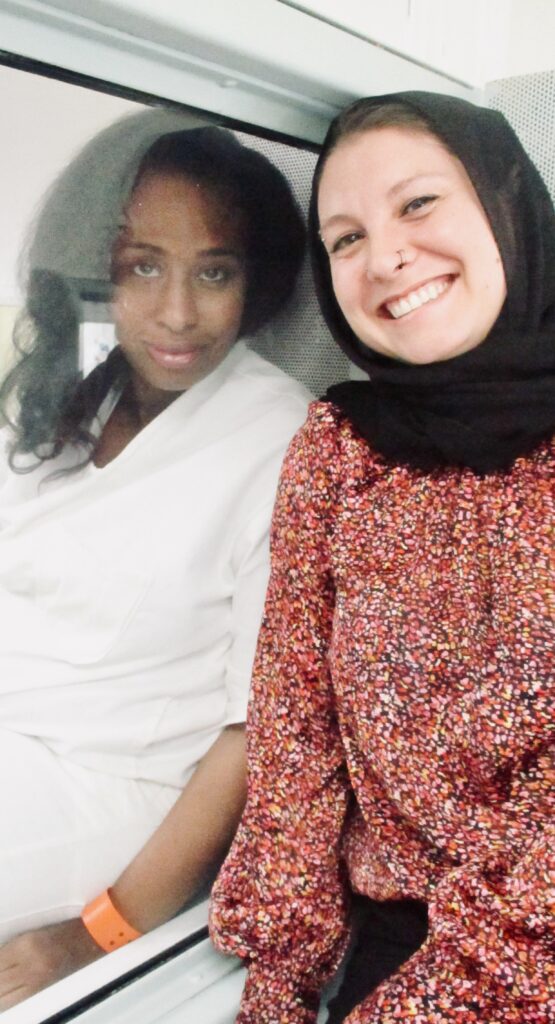
This was my first time meeting my colleague Kwaneta Harris in person. My face lit up when she walked into the room. We had been working together, corresponding through the prison email and over the monitored phone, for over two years at this point. But you never really know how it will feel to meet someone in real life. Her face lit up too. We pressed our hands up against the plexiglas window separating us.
In Texas, anyone not in the incarcerated person’s immediate, nuclear family can only visit across the glass. Kwaneta explained that even grandparents get refused contact visits for not fitting the “immediate family” definition. The prison has a separate behind-the-glass section in the visiting room just for us. The incarcerated women can reach their hands out and touch each other from where they sit on their side of the glass, but I will never be able to hug Kwaneta until she comes home from prison.
Then there’s the separate administrative segregation part of the visiting room. Those women are handcuffed in a telephone booth-sized box, and their families are crammed in on the other side of the glass. My heart sank further into the floor when Kwaneta shared the circumstances of some of the women on the other side of those telephone booth cubes. Many of them ended up in solitary confinement because they rejected a male guard’s sexual advances.
Sexual transactions are routine between male guards and female incarcerated women in Texas. Kwaneta once told me the most difficult thing for her to teach the girls and women in there was what a consensual relationship actually looks like. Many of them came to prison so young that the only relationships they knew were coercive, abusive—not to mention illegal—dynamics with the guards. In Texas, the guards will demand that a girl or woman give him oral sex or expose her body to him just to receive tampons, toilet paper, or soap. When a woman says no, she ends up in the hole.
Kwaneta and I talked about everything from our work at Solitary Watch to the conditions at Lane Murray to our family histories to our favorite foods. Of course, I made sure to bring enough money to raid the vending machines for any and all the food Kwaneta’s heart desired. She had never had Takis! In the “free” world, I try to keep my loved ones away from anything with toxic food dyes, but in a place where she can’t just walk down the street to the store, when my friend wanted to try Takis, I felt like, at least you have to taste them once in your life!
I asked Kwaneta about the forced labor in the fields. I had read her article, and we had talked about it before. But sitting in the very space where armed guards sit atop their horses barking orders at incarcerated women to pick crops, it felt different when Kwaneta explained the reality. In Gatesville, she explained, the warden lives in a house on the prison compound. Not only are the women forced to work in the fields, but incarcerated women clean and maintain the house of the warden with no compensation and under threat of punishment.
I emphasize the lack of compensation because even in Pennsylvania, where I live now, incarcerated people can earn a meager 50 cents per hour. It’s abominable that is the highest an incarcerated person can earn. And yet, it creates an even more dangerous dynamic when there’s no possibility to earn even 10 cents an hour. Nothing. In Texas, there is no compensation for any prison labor, ever. This means that the women have no way of earning money to pay for those tampons, so when a male guard demands that she put her lips to his penis, it’s either that or bleeding out on the floor of her cell.
Heading back to my hotel room in Gatesville that night, my body felt the weight of the silenced violence occurring every day inside those prisons. My skin felt the thickness of the air in that town, whose economy thrives on the forced labor and sexual exploitation of criminalized women. Tears streamed down my face wondering how the women’s bodies trapped inside those prison walls can sustain carrying the weight of this system, when mine could barely hold an eight-hour glimpse of it.
I will never unsee what I saw in that Texas prison. The love and laughter that dampened as the guards shuffled us all out of the visiting room. The chunky baby in the sombrero being ripped away from her mother. The humiliated look in the eyes of the Muslim woman guard who said, “It’s just my job” when she forced me to remove my hijab despite my requests for privacy. The sprawling fields resembling a slave plantation with the master “warden’s” house propped up in the middle.
For me, it was an honor to spend those eight hours with my colleague, who has chosen to risk her own freedom for the sake of exposing the violent oppression that happens both in the darkest black holes behind prison walls and out in the fields of an isolated prison town that most Texans, let alone “Northerners,” will never set foot in.
The most profound pain of any visit is leaving. Pulling my hand away from the hand of a colleague, a friend, a loved one always feels wrong. Walking back out through those gates feels wrong. It’s a completely distinct world in prison from outside the walls. Even just a peek inside unveils flagrant violations of human rights, rampant sexual assault and harassment, routine dehumanization, heinous medical and mental health neglect, and wrongful death obscured from public view. It lights a flame in my soul to be forced to leave any human being in those conditions, and it is this fire that drives my devotion to work towards our collective liberation.
• • • • • • • • • •
Kwaneta
The worrying starts weeks before anyone touches Texas soil. The moment a visit is approved, I begin building a version of myself that won’t give them a reason to take it away. I stop rolling my eyes. I stop sighing when an order makes no sense. A grievance filed against staff, even a legitimate one about mistreatment, means ten days with no visits while they “investigate.” A single write-up, even for something as small as a look on my face, can cancel a visit that took a month to approve and a flight to make it real. I can’t even go to a hospital appointment in that window, because leaving the prison grounds automatically cancels it too. So I hold my breath and my tongue, and I wait.
Then there’s the uniform. We don’t have access to irons. So, I wash it by hand and lay it soaking wet on the floor, using the bottom of a mug to press a crease into the pants and sleeves. I stick it wet against the brick wall and aim my fan at it until it dries stiff and straight enough to pass. My cell has to be spotless too—not one extra lotion bottle out of place—or the visit is off before it starts. None of this guarantees anything. It just gives me the illusion of control over a system built to take control away.
By the time a visitor is actually flying in, especially from up north, I’ve given them my own version of The Talk. Black parents give their children a version of this speech about surviving encounters with police. Mine is for people coming to see me in Texas. I tell them not to be shocked when they see people walking around with firearms because this is an open carry state. I warn them about the pickup trucks in the employee parking lot with Confederate flags and “Repeal the 19th” stickers, and I tell them what not to wear. No white, because that’s our uniform. No leggings, because guards have claimed they’re too sexually arousing for us to see. I tell them that the visit will be noncontact unless they’re immediate family, that we’ll speak through a phone with plexiglass between us, and that the room will likely be empty because nobody visits women here the way they visit men.
The unspoken lesson underneath all of it is the same one Black parents teach their kids about police. Don’t talk back. Don’t question authority. Get home safe. I tell my visitors to expect to get pulled over just for driving toward the prison, to expect an officer to ask who they’re visiting and they’ll mention a cousin or an uncle who works inside, and to answer every question without pushback. I tell them not to stay anywhere near the prison and to drive the two hours to Austin instead. This is what love looks like from behind glass: coaching the people who love you on how to survive loving you.
Valerie Kiebala, my friend and colleague at Solitary Watch, flew in from Philadelphia this past December. We’d written to each other without ever seeing each other’s faces, and when we finally pressed our hands against the plastic that separated us, it felt like meeting someone I’d known my whole life. She bought overpriced snacks from the vending machine, the closest thing to a shared meal we’re allowed.
Looking around that visitation room, most of the people there weren’t family. They were mostly young, attractive incarcerated women, and older men visiting them. And I later learned that for some, what looks like a loving visit is closer to a transaction, a few hours of snacks and air-conditioning traded for vile things said over a phone line.
I don’t judge those women. I’m ashamed to say I’ve sat through visits like that myself because sometimes the alternative to bad company is no company at all.
Valerie is a Muslim woman, and I knew before she arrived that Islamophobia would find her in this part of Texas. I hoped it would stay quiet—a look, a whisper between guards. I was wrong. Texas has made national news repeatedly for anti-Muslim rhetoric, from state lawmakers pushing bills that target Muslim communities to local officials making public comments that mirror what happened to Valerie that weekend. None of it surprised the staff around me. All of it appalled and enraged my friend.
During our four hours together, I never used the restroom, because leaving to be strip-searched again wouldn’t stop the visitation clock, and I couldn’t risk losing a single minute of the little time we had. That’s a small thing until you realize how many small things get quietly stolen from you in a visitation room. On my way back to my unit, I was stopped by two sergeants and a major, who asked what “that” was that had come to see me. I said her name, Valerie. They asked whether she was a man or woman. The major told me her license listed her as male, and that if she returned the next day, she personally would make sure a male sergeant conducted her search. She said she’d seen photos of Valerie without her hijab online, and told me plainly. “We ain’t playing that Muslim shit down here”.
I walked back to my cell holding two truths at once. They can do almost anything to me, and I have learned to survive it. But I was not willing to let them do it to someone who flew over a thousand miles to hold her hand against glass for me. I called Valerie and told her not to come back the next day. She told me the license was a clerical error, that she carried her passport too, and that she would sort it out with the DMV once she was home in Philadelphia. Then she came anyway.
This is not incompetence. It is not overcaution or bad luck. It is the design. Every strip search for a visit where we never touch, every rejected rainbow T-shirt on a toddler, every canceled visit blamed on a barking drug dog that found nothing, every family accused of “speaking in code” because they spoke their own language. All of it is engineered to make visiting us so exhausting and so humiliating that people eventually stop coming. Fewer visitors means fewer witnesses, fewer witnesses means fewer questions about what actually happens inside these walls. That is the goal, plain and simple. And when nobody is watching, when the room stays empty and the outside world stops asking what conditions look like in here, violence does not shrink. It grows, quietly, in the space they’ve cleared for it.
Every obstacle in this process is by design. The bogus infractions, the warnings about Texas roads, the plantation fields in plain view, and the contempt aimed at a visitor’s faith—all send the same message: stay away. Still, one thing remains stubbornly out of their reach: our refusal to be separated. The system miscalculates what connection means to us. They can take our time, our dignity, and our sense of safety on the drive home, but they cannot take the bond that brought us to that visiting room. Each visit is proof their strategy failed. We keep showing up, we keep writing, and we will keep tearing down this system until there is nothing left of it to steal from anyone.
COMMENTS POLICY
Solitary Watch encourages comments and welcomes a range of ideas, opinions, debates, and respectful disagreement. We do not allow name-calling, bullying, cursing, or personal attacks of any kind. Any embedded links should be to information relevant to the conversation. Comments that violate these guidelines will be removed, and repeat offenders will be blocked. Thank you for your cooperation.